A Flexible Set or a Detailed Room: Two Ways to Suggest Place
A flexible set or detailed room can shape how audiences imagine a play’s world. Compare their effects and choose what a scene needs to show.
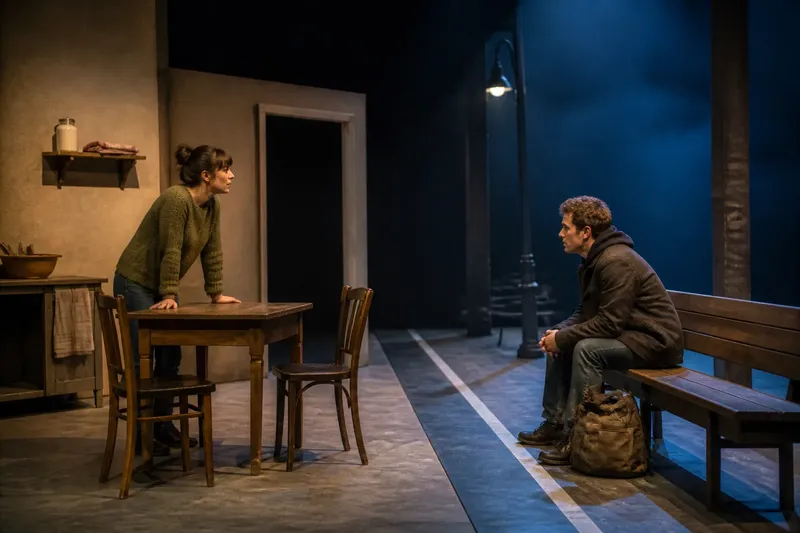
A rehearsal room holds a wooden chair, a narrow table and a square of painted floor cloth. The play’s first scene is in a kitchen; the next is on a station platform. For the production designer, the choice is not simply what furniture to build. A flexible set or a detailed room tells the audience how much of the world to imagine for itself.
What does each approach ask the audience to imagine?
A flexible set offers a few objects or shapes that can suggest several places. A chair may serve as a kitchen seat, then become a waiting-room perch when the actors change how they use it. A shift in light, sound or movement can help locate the next scene without replacing the whole stage picture.
A detailed room, by contrast, gives a scene a particular physical identity. A sink, a crowded shelf, a patterned curtain and a door with a visible latch imply a domestic routine and its limits. The audience is given more clues about the people who occupy the space, while the production takes on the work of selecting and arranging those clues.
Neither approach is inherently more imaginative. Spareness can make a small object carry several meanings; detail can make one place feel socially and emotionally specific. The useful question is what the scene needs viewers to notice, and what it can leave open.
How does the invented kitchen-and-platform production develop?
Imagine a small theatre planning a play about two siblings who argue in their mother’s kitchen and later meet on a station platform. The director and designer begin with an invented constraint: the same stage must move between the scenes in view of the audience. Their first proposal is a detailed kitchen, with a freestanding sink, shelves, a table, chairs and a doorframe. It gives the opening a strong domestic texture, but each later scene risks feeling like a visit back to that room unless the change is clear.
They try a second proposal: a table, two chairs and a long bench that can become a platform seat. A shift in the actors’ arrangement, a cool wash of light and the sound of a departing train distinguish the station. The sibling who once leant on the kitchen table now waits at the bench, leaving a visible gap between the pair. The expected result is not a more realistic station, but a change in how the audience reads the same objects and the relationship between them.
As the idea develops, the team chooses a mixed arrangement. The kitchen receives a recognisable table and a single shelf with a jar and a folded cloth; the sink and doorway remain suggested rather than built. The station keeps the bench, while a narrow strip of floor marking establishes the platform edge. Transitions are carried by the actors moving furniture and by the lighting shift, not by an attempt to recreate every location in detail.
This invented case makes the trade-off visible. Too little information could leave the platform indistinct, while a fully furnished kitchen could hold attention on the wrong details during the later scene. The compromise gives each place a few legible anchors and asks performance, light and sound to complete the picture.
When is a flexible set the stronger choice?
Flexibility can suit plays with frequent location changes, quick transitions or scenes whose emotional continuity matters more than their geography. Reused furniture also lets actors make the change legible through behaviour: setting a chair carefully may suggest domestic habit, while turning it away may make the same object feel impersonal.
It helps to check whether the production’s recurring objects can change meaning without becoming confusing. A table used in several scenes may gather associations, but if the audience cannot tell whether it is meant to remain the same table or represent a new place, the staging may need another cue. A sound, a shift in the actors’ focus or a simple change in light can clarify the transition without adding scenery.
Flexible staging is not automatically minimal in its demands. It asks for precise choices about movement, sightlines and transitions. If every place depends on the same vague arrangement, the audience may have too little to orient itself.
When does a detailed room earn its space?
A more fully specified setting can be valuable when the room itself shapes the action. A narrow doorway may make an entrance feel difficult; a visible family photograph may prompt a character to avoid looking at the wall. Details earn their place when actors can use them or viewers can read them as part of the scene, rather than as decoration added to make the set appear complete.
For a designer, selection matters more than accumulation. A practical object can give an actor something to handle, while a carefully chosen surface or colour can distinguish one household from another. If a detail does not affect movement, mood or the audience’s understanding of the people, the production may be able to leave it out.
A detailed room can also narrow interpretation. A carefully furnished kitchen may make a family seem prosperous, cramped or orderly before anyone speaks. That specificity can enrich the play, but it should fit the characters and the world the production intends to show.
Which design questions help choose between them?
How many locations does the play need to suggest?
Frequent changes may favour a small group of reusable objects, especially when transitions are part of the performance. A play that stays in one consequential room may benefit from details that let the audience understand its routines and boundaries.
Which objects affect the action?
Keep the items actors touch, move or respond to as part of the design discussion. Other details should earn their place by making a clear contribution to atmosphere or the audience’s understanding of the setting.
Can viewers read each transition?
Consider what changes in the light, sound, furniture or actors’ behaviour when the place changes. If the shift remains unclear, add a distinct cue rather than asking scenery alone to carry every part of the storytelling.
What should remain open to interpretation?
Some plays benefit from leaving the surrounding world indefinite, so viewers can supply their own associations. Others depend on a particular social environment, where selected physical details make the pressures of the scene easier to perceive.
How can the design choice stay purposeful?
Return to the invented siblings’ play and ask what the audience should notice in each scene. In the kitchen, the shelf and table support the sense of shared routine; at the station, the bench and marked edge make waiting and distance readable. The objects are not there to furnish a complete world. They give the actors a physical structure for making the change in place and relationship visible.
For a flexible set or detailed room, a useful decision begins with the scene’s action, not a preference for either abundance or restraint. List the places, identify the objects the actors genuinely use, and decide which features the audience needs in order to follow the shift. Then consider what light, sound and movement can express without another piece of scenery.
That approach leaves room for a production to be spare in one scene and specific in another. The audience can imagine beyond what is built, while the design still offers enough evidence to make each place feel intentional.