Why a Pause Can Change the Meaning of a Line
Why a pause can change the meaning of a line: learn to hear the expectation it creates, the emphasis it shifts and the choice behind each silence.

The actor says, “You came back,” then waits before adding, “after all.” In that small gap, the audience has time to decide whether the return is welcome, surprising or a fresh disappointment. To understand why a pause can change the meaning of a line, listen not only for the words but for the thought the silence lets you expect.
What does a pause ask the audience to expect?
A pause is not an empty space between bits of dialogue. It is time in which an audience may anticipate a reply, notice a reaction, or revise its understanding of what has just been said. The words before the silence create a question, even when nobody has asked one aloud: What comes next, and what will it mean?
That expectation can be quite specific. After “I know where you were”, a pause may make the listener expect an accusation. After “I know where you were …”, the same words can sound as if the speaker is deciding whether to reveal how much they know. The line stays put; the audience’s forecast changes.
Expectation is especially vivid in live performance because it is shared and immediate. A roomful of people may lean towards the same possible response, while an actor’s stillness, gaze or breath either confirms that direction or quietly alters it. The audience is not simply waiting for the next sentence. It is actively supplying possibilities.
How does the place of silence shift emphasis?
Compare three ways of delivering the same thought: “I thought you’d call.” A pause before the line can suggest that the speaker has been weighing whether to say it. A pause after “thought” may draw attention to the uncertainty inside that word. A pause after the whole line leaves the other person, and the audience, to decide how much hurt or accusation to hear.
These are not fixed meanings. An actor’s tone and the surrounding scene matter, as does what the audience already knows. But a silence tends to make the words beside it feel newly important. The pause can frame a phrase as an admission, give a listener time to absorb a revelation, or expose how difficult a reply is to produce.
Consider the difference between a pause that separates and one that connects. A gap before “but” can make the word sound like a correction to the preceding thought. A gap after “but” can make the audience wait for the thought that the speaker has not yet managed to say. In either case, the audience starts listening for a turn in the meaning.
Which kind of pause are you hearing?
Does the silence make a character seem uncertain?
It can, especially when the character appears to search for a word, reconsider a claim or avoid another person’s eyes. Listen for whether the pause holds a thought in progress or makes the speaker seem to have lost control of it.
Can a pause make a line sound threatening?
Yes: a measured delay can make the audience anticipate a consequence, particularly when the speaker stays calm while another character waits. The threat may come less from the words than from the sense that the speaker is choosing what to say next.
How is a pause different from a beat?
In rehearsal, “beat” often means a shift in thought or action, while “pause” describes time in the delivery; actors and directors may use the terms differently. As an audience member, it is more useful to notice what changes during the silence than to decide which label applies.
Why can an audience laugh during a silence?
A pause can leave space for recognition: people may notice an awkward truth, a mismatch between words and behaviour, or the timing of a reply that never arrives. The laughter is part of the room’s response, and the next line may land differently because of it.
What does the silence let the other character do?
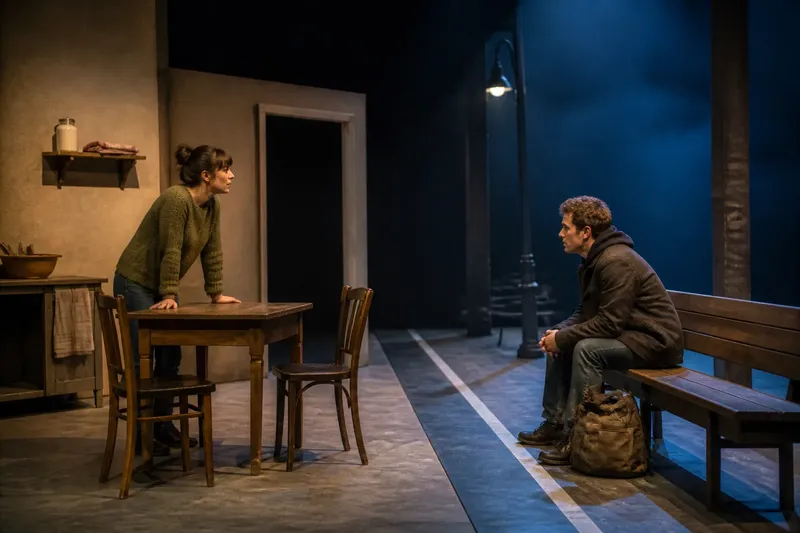
A pause can make the listener’s response visible without giving them a line. They might look away, reach for a cup, hold their ground or offer a smile that arrives too late. Those actions become part of the exchange, and the audience watches whether the speaker notices them.
This can change the balance between characters. A speaker who pauses while maintaining eye contact may appear to demand an answer; a speaker who looks away may seem to retreat from one. The other character’s stillness can read as refusal, confusion or restraint. The meaning lies in the relationship between the silence and what people do inside it.
Imagine a scene in which Mara asks Ben, “You kept the letter?” and he does not answer at once. If Ben reaches towards a drawer and stops, the audience may anticipate an explanation or a confession. If he instead looks directly at Mara, the same silence may feel like a challenge. These are invented possibilities, not rules: the scene’s earlier events and the actors’ choices shape which expectation takes hold.
How do different approaches to silence compare?
One approach is to make the pause feel like active thought. The actor seems to be deciding, remembering or withholding; small changes in breath and focus keep the silence alive. This suits scenes where a character’s choice is the centre of attention, such as a confession, a negotiation or an attempt to say something difficult. The audience listens for the thought taking shape.
A second approach treats the pause as a space for the other character. The speaker waits, but attention settles on the person who has been addressed. This suits exchanges in which power, embarrassment or refusal is carried by the response that does not arrive. The audience watches the listener, and may start to anticipate an answer, a gesture or a break in the exchange.
A third approach lets the room itself hold the silence. Instead of pointing clearly towards a decision or response, the pause gives the audience time to absorb an image, a change in atmosphere or the weight of an earlier line. This can suit moments of discovery or emotional aftermath, where an immediate explanation would narrow the effect.
To choose among these approaches, ask what the audience should be anticipating at that point: the speaker’s decision, the other character’s response, or the chance to take in what has happened. Then listen for whether the actor’s focus and the scene’s rhythm support that expectation. A silence that points in several directions at once may feel rich; one that does not seem connected to anything may feel merely delayed.
What can you listen for in the theatre?
You do not need to count seconds or decide whether a pause is “long enough”. Attend to the change it creates. A few questions can make the silence easier to hear:
- What did the last word lead you to expect? Notice the reply or revelation you begin to anticipate.
- Where is attention directed? The speaker’s face, the listener’s hands or an object in the space can guide your focus.
- Does the silence alter your reading of the line before it? A hesitation may make certainty sound doubtful; a delay after a claim may make it feel newly exposed.
- What happens to the room? A laugh, a held breath or a restless shift can show how the audience is responding, though no single reaction speaks for everyone.
- What changes when speech resumes? The next words may confirm the expectation, turn it aside or make the silence itself seem significant.
These questions are useful in a brisk exchange as well as a quiet scene. In rapid dialogue, a brief gap can mark a sudden change of allegiance or reveal that a joke has struck a nerve. In a longer silence, watch for small adjustments rather than assuming that nothing is happening.
When does a pause change the line most?
The strongest pauses often alter the audience’s expectation without announcing that they are doing so. A speaker may appear ready to agree, then use the silence to reconsider. A listener may seem about to answer, then let the moment pass. The audience notices the gap between what seemed likely and what actually follows.
That is why the pause after a line can matter as much as the line itself. It gives the audience room to hear an implication, but it also leaves the interpretation open. When you want to understand why a pause can change the meaning of a line, follow the expectation through the silence: what you thought would happen, what the actors made visible, and how the next words changed the picture.
At the next performance, choose one exchange and listen for the instant before a reply. If the silence makes you revise what you thought the speaker meant, you have heard not an absence of dialogue but a turn in the storytelling.