Before the Modern Play Script: How Stage Directions Took Shape
How stage directions took shape becomes clearer through dated plays and editions, helping readers distinguish playwrights’ cues from later editorial and theatrical additions.
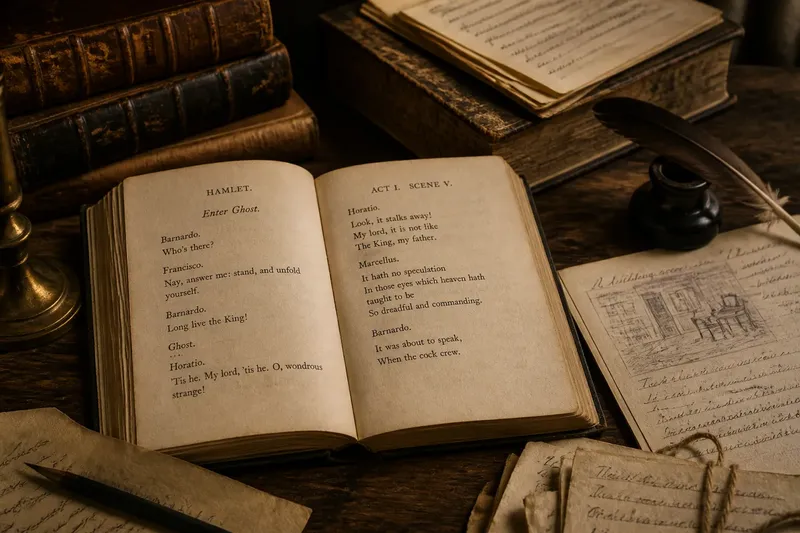
Open a printed copy of Shakespeare’s Hamlet and you may find a compact cue such as “Enter Ghost”, followed by a long exchange in which the characters describe what they see. Compare that with the stage directions in a modern script, where a playwright may specify a room, a sound and the exact handling of an object. How stage directions took shape is not a simple march from silence to detail: the surviving page reflects changing theatre practices, printing and editorial choices.
Specific plays and editions make that history easier to see. The comparison below focuses on what the texts put on the page, not on a claim that every company staged them in the same way. A sparse printed direction does not mean the actors lacked a plan; it means the page preserves only part of the evidence.
What can an early printed play tell us?
In Shakespeare’s Hamlet, first printed in quarto in 1603 and in a substantially different text in the 1623 First Folio, directions such as “Enter Ghost” give a basic cue for an entrance. The dialogue then supplies much of the encounter: characters call attention to the Ghost, react to it and describe what they perceive. That combination lets words carry information that a later script might place in a setting note or a fuller account of movement.
The two early printed texts also caution against treating a play as one perfectly stable page. Their wording and stage directions differ, and neither printed version is a transparent record of every detail used in a particular performance. A reader can compare what each edition preserves, but should not infer that every absent instruction was absent from rehearsal.
Elizabethan and Jacobean companies used shared theatrical conventions, and their scripts could serve performers who knew the work of the stage. Entrances, exits and objects still had to be managed, but not every practical cue needed to be spelled out for a company familiar with its play. The precise division between spoken text, written direction and rehearsal knowledge varied; a printed script alone cannot settle it.
How did publication change the page?
As plays circulated in print, the text had readers beyond the company that performed it. A direction could help someone follow who entered, locate an action or imagine a scene without seeing it staged. Printing also introduced complications: manuscripts could be copied, set in type and revised, while later editors might clarify or add directions to make an older play easier to read.
Ben Jonson’s Every Man in His Humour offers a concrete early example. Jonson’s 1616 folio presented his plays as a collected literary work, rather than only as scripts tied to a single performance. The volume’s publication context matters: a direction in a collected printed text belongs to a particular version and editorial history, not automatically to every staging the play had known.
Compare editions before making claims about an author’s intention. If one version includes an entrance cue and another does not, note the difference and identify the edition in view. That is more dependable than treating the fuller text as unquestionably original or the shorter one as proof that the action was improvised.
When did settings become more explicit?
By the nineteenth century, many plays appeared in editions with substantial descriptions of place and action. Henrik Ibsen’s A Doll’s House, published in 1879, begins with a detailed account of the Helmer family’s sitting-room: its furniture, doors and general arrangement. This gives readers and theatre-makers concrete information about the scene’s domestic setting, while leaving room to decide how the room should look in any particular production.
Such detail can be read alongside theatrical change, but it should not be reduced to a single cause. A playwright may describe a room to establish social circumstances, support a sequence of action or guide a reader’s imagination. A director and designer still decide how to make those details legible on stage, within the production’s chosen style.
The comparison with Hamlet is useful, but not absolute. Shakespeare’s text also contains practical directions, and Ibsen’s does not dictate every movement or emotional response. The difference lies in the kind and amount of information recorded in these particular texts, not in a clean boundary between an undirected past and a fully controlled modern theatre.
What do directions ask a production to do?
Directions can identify an observable event, such as an entrance, or propose a quality of movement, sound or place. They may also affect practical work: an object has to be available, an actor must be able to handle it, and the timing must make sense to the audience. These needs do not turn the page into an operating manual. Rehearsal is where a company works out how the written action can be performed.
Imagine a hypothetical scene in which a character arrives at a train platform carrying a sealed envelope. The script says the character places it on a bench before another performer enters. The actor and stage manager can mark when the envelope is set down; the props team can supply a visible, safe-to-handle envelope; and the director can check that the audience sees the exchange without losing the next line. The resulting decision is practical: keep the envelope on the bench if it remains visible and does not obstruct movement, or have the actor hold it if the bench placement makes the action hard to follow. The direction fixes an event, while the production chooses a workable form.
For actors, a physical instruction does not settle a character’s inner life. “She turns away” gives a playable action, but not its sole meaning. For designers, a named object or location is a clue to what may need to appear, not always a demand for a literal, fully built environment.
How stage directions took shape across these examples?
There is no single timeline that fits every play or edition. These questions help keep the evidence specific while tracing how stage directions took shape in the texts above.
Why does Hamlet have so few directions in some editions?
The early printed versions of Hamlet preserve different wording and directions, and the spoken text itself conveys much about the Ghost’s appearance and the characters’ responses. Sparse cues in one edition do not establish that a performance used no planned movement.
Does Jonson’s 1616 folio record the original staging?
It records a collected printed version prepared in a literary context, not a complete promptbook for every performance. Readers can use it as evidence for that edition while avoiding claims about unrecorded rehearsal choices.
Why does A Doll’s House describe its room?
Ibsen’s 1879 text gives readers and theatre-makers a specific domestic setting to work from. The description informs staging, but a production still decides how to represent the room and what visual details deserve emphasis.
Can an editor add stage directions?
Editors may supply or clarify directions, especially when preparing older texts for new readers or performers. Check the edition’s notes and compare versions where possible before attributing a particular cue directly to the playwright.
How can you read a direction without overclaiming?
- Check the edition named on the title page. If it identifies a quarto, folio or modern edited text, use that label when describing the direction; if the edition is unclear, avoid assigning the cue to a specific early version.
- Compare the same passage in another edition. If the cue differs, record the variation; if you cannot compare versions, treat the wording as evidence from the copy in hand only.
- Separate dialogue from printed instruction. If characters describe an action aloud, distinguish that spoken evidence from a bracketed or italicised direction; if the typography is ambiguous, consult the edition’s editorial note.
- Identify what the direction makes observable. If it specifies an entrance, object or sound, describe that event; if it suggests emotion, avoid presenting one interpretation as the only possible reading.
- Ask whether the instruction is essential to the action. If removing it would make a later event unclear, preserve its function in performance; if the dialogue already communicates the event, a production may choose a less literal staging.
- Check for an editorial explanation. If a note identifies a supplied direction or textual variant, cite that qualification; if no explanation is given, do not claim certainty about who first wrote the cue.
For a reader, the most useful habit is to keep the evidence and the inference separate: “this edition prints an entrance here” is a textual observation, while “the playwright required this exact entrance” is a stronger claim that may need more support. How stage directions took shape is visible in the changing relationship between dialogue, printed instruction and theatrical work, but no page contains the whole performance. When describing a play, naming the edition and pointing to the specific cue lets other readers see where the evidence ends and interpretation begins.